
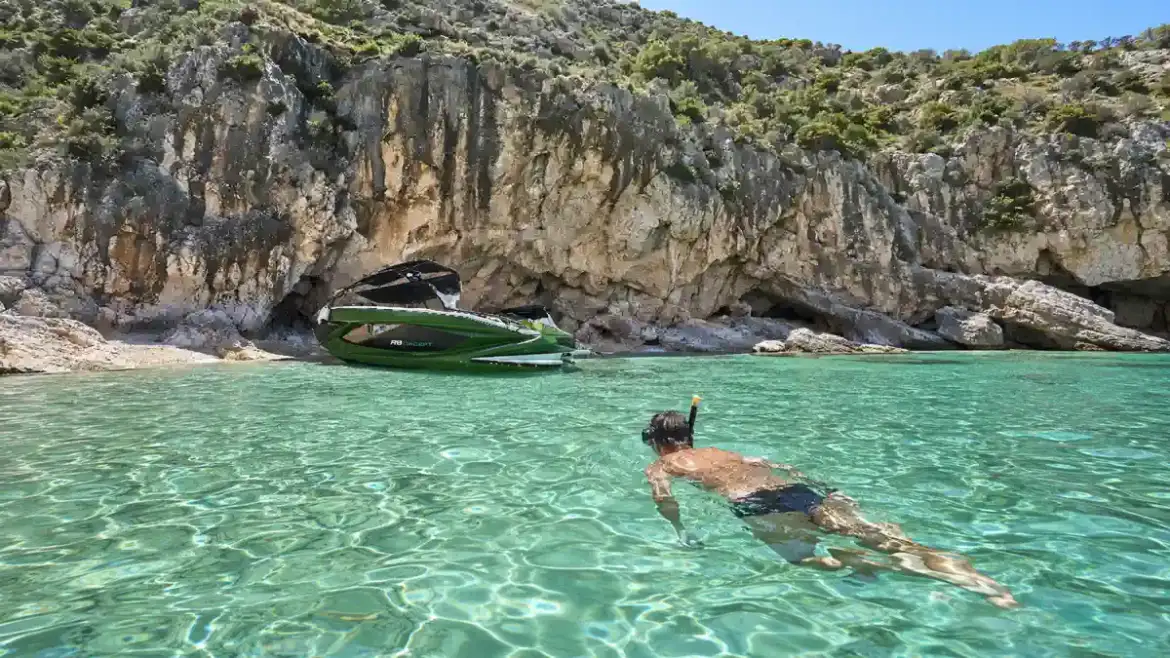
Snorkeling in Himara is surprisingly simple. You don’t need to join a diving course or travel far from town. In many places, all it takes is a mask, a calm morning and a few steps into the Ionian Sea.
The first thing you notice is the visibility. Even before entering the water, you can often see the stones on the bottom. Once you put your face below the surface, the coast looks completely different. Small fish move between the rocks, sunlight passes over the seabed and patches of seagrass appear where the water becomes deeper.
Don’t expect a tropical coral reef. That isn’t what Himara offers. The underwater scenery here is Mediterranean: rocky shelves, pebble bottoms, narrow caves and clear blue water.
Some beaches are suitable for a relaxed swim from shore. Other places are difficult to reach without a boat. Knowing the difference will help you choose where to spend your time.
Start With Aquarium Beach
Aquarium Beach is probably the most obvious place to try snorkeling near Himara. The bay is small, protected by rocks on both sides and known for water that changes from pale turquoise near the beach to a darker blue farther out.
It is a comfortable choice for beginners because there is no need to swim a long distance. You can start close to shore, test your mask and slowly move toward one of the rocky sides.
The edges of the bay are more interesting than the middle. Fish tend to stay closer to rocks and shaded areas rather than over an empty seabed. There is no reason to rush. Moving slowly also prevents sand and small stones from being disturbed, which helps keep the water clear.
Aquarium Beach does have one disadvantage. It has become popular, and the bay is not large. During July and August, it can feel crowded by late morning. If snorkeling is your main reason for visiting, go early.
You can see its location and learn more on the Aquarium Beach destination page.
Gjipe Looks Different From the Water
Most people visit Gjipe because of its canyon. They walk behind the beach, take photographs between the cliffs and spend the rest of the day near the shore.
The water is often treated as a background, which is a mistake.
The middle of the bay has a relatively open seabed, but the rocky sides are more interesting. Swimming along one edge gives you a view of submerged stones, shadows beneath the cliffs and fish moving through the shallower sections.
You should still pay attention to boat traffic. Gjipe receives regular boat arrivals during summer, so swimming directly across the entrance of the bay is not a good idea. Stay visible and choose one side rather than moving through the centre.
Reaching Gjipe Beach by boat also saves you the walk down to the coast. That matters on hot days, especially if you’re carrying towels, water and snorkeling equipment.
Pigeon Cave Is About the Light
Pigeon Cave offers a different kind of swim.
At an open beach, the sunlight reaches the seabed evenly. Near the cave, the colours change as you move between open water and shadow. The rock looks darker, while the water near the entrance can appear brighter because of the reflected light.
That contrast is what makes the place memorable.
There is no need to swim deep inside. In fact, you shouldn’t enter a sea cave without first checking the conditions and listening to the skipper. A cave that feels calm on one day may be uncomfortable when waves are entering from the wrong direction.
Stay near the opening and take your time. Looking back toward the sunlight is often more impressive than looking toward the darker interior.
Our guide to Pigeon Cave Albania explains more about the cave and the coastline around it.
Pirate Cave Isn’t Always a Swimming Stop
Pirate Cave is one of the best-known sights along this section of the Riviera. Almost everyone wants to see it, and many visitors assume they will automatically be able to swim there.
The sea makes that decision.
When the water is calm, swimming near the entrance can be a great part of the trip. You get a closer look at the rock and hear how every sound changes inside the cave. Even small splashes seem louder.
When the sea is moving, it is better to remain on the boat. Waves can push swimmers toward the rock, and the space near the entrance may feel tighter than it appears in photographs.
Skipping a swim does not mean missing the cave. The approach by boat is already part of the experience, and there are usually safer places to enter the water farther along the route.
Before visiting, you can read the full article about Pirate Cave in Himara.
The Quiet Stops Are Often Better
The most famous destination is not always the best place for snorkeling in Himara.
Small bays can be far more enjoyable, particularly when there are no beach bars, crowds or boats constantly arriving. Some of these places don’t have widely recognised names. They are simply sheltered sections of coast where the skipper knows the water is suitable for swimming that day.
This is one advantage of exploring by boat. You aren’t tied to a single beach.
If one stop is busy or the water is unsettled, the route can continue to another bay. A few minutes around a headland may be enough to find calmer conditions.
Crystal Beach, Couples Bay and the smaller swimming spots along the coastline all offer this kind of experience. They may not provide a dramatic cave or a famous viewpoint, but they give you something more useful when snorkeling: space.
The Himara destinations page includes several of the beaches and caves that can be combined during a coastal trip.
What About Grama Bay?
Grama Bay deserves a full day rather than a quick stop.
The journey from Himara is longer, and the coast becomes wilder as the boat travels north. By the time you arrive, you’ll probably want to spend part of the visit on the beach before entering the water.
For snorkeling, look toward the rocky sides of the bay rather than remaining directly in front of the beach. The central area is better for swimming, while the edges provide more variation beneath the surface.
Grama can also become busy in peak summer. Arriving earlier gives you a quieter beach and clearer space in the water before more boats enter the bay.
Although reaching Grama on foot is technically possible, it is not a casual walk. The article Can You Visit Grama Bay Without a Boat? explains the difference between hiking and travelling there by sea.
Should You Go From Shore or Take a Boat?
If you only want an hour in the water, choose a beach.
Aquarium, Livadhi, Jalë and several other nearby beaches allow you to snorkel without booking an excursion. You control your own schedule and can stop whenever you want.
A boat tour makes more sense if you want to see caves or combine several swimming locations. It also removes the problem of reaching remote beaches over rough paths.
The Himara Coastline Tour includes beaches, caves and planned swimming stops within the same trip. Instead of spending the day driving and walking between locations, you follow the coast from the water.
Group tours work well when you are comfortable following a fixed schedule. They are social and usually more affordable for one or two travelers.
A private tour is better when snorkeling is the priority. You can ask for longer swimming stops, avoid crowded bays and adjust the route more easily when conditions allow.
You can compare the available group boat tours in Himara with the private boat tours before deciding.
Morning Usually Wins
There is no exact hour that guarantees clear water. Weather matters more than anything else.
Even so, mornings are normally the safer choice for snorkeling. The sea is often calmer, the beaches are quieter and the summer heat is easier to manage. You also have more energy than you would after spending several hours in the sun.
Afternoons can still be enjoyable, especially if you want to combine swimming with warmer light and sunset views. The problem is that wind and waves may increase later in the day.
Ask about conditions before leaving instead of relying only on the time printed on the booking.
For a closer comparison, read our guide about the best time for a boat tour in Himara.
Bring a Mask That Actually Fits
A cheap mask that constantly fills with water can ruin the experience.
Before entering the sea, place the mask against your face without using the strap and breathe in gently through your nose. If it stays in place for a moment, the seal is probably suitable. Hair trapped beneath the edge can also allow water to enter.
Bring a towel, drinking water, sunscreen and something to protect your phone. Water shoes are useful on beaches with large pebbles or slippery rocks.
Fins are optional. They help you move with less effort, but beginners sometimes find them uncomfortable. If you use them, put them on after entering the water rather than trying to walk across the beach while wearing them.
Ask whether equipment is included before booking. If you have your own mask and know that it fits properly, bring it.
A Few Rules Worth Remembering
Never snorkel alone, even when the water looks completely calm.
Tell someone where you are swimming and stay within the area recommended by the skipper. Boats may approach beaches quickly, so avoid crossing open arrival routes.
Keep some distance from cliffs when waves are present. Do not enter caves simply because another swimmer has gone inside. People have different abilities, and conditions can change within minutes.
If you are not confident in deeper water, use a life jacket or flotation aid. There is nothing embarrassing about it. Feeling secure allows you to breathe normally and enjoy what you are seeing.
Children need constant supervision. A life jacket helps, but it does not replace an adult nearby.
Finally, leave the seabed as you found it. There is no need to touch fish, move stones or take shells from the water.
What Will You Actually See?
This is a fair question, especially when travel advertisements promise an “underwater paradise.”
The honest answer is that every day is different.
You are likely to see small coastal fish, rock formations, pebbled bottoms, seagrass and areas where sunlight creates moving patterns on the seabed. Around caves, the main attraction is often the colour of the water rather than marine life.
You may see more. You may see less.
Snorkeling here isn’t about chasing one rare species. It is a slow way of experiencing a coast that most people only view from a beach chair or the side of a boat.
Take Your Time
The common mistake is trying to cover too much distance.
You don’t need to swim across an entire bay. Choose a rocky edge, move slowly and occasionally stop kicking. Fish are easier to notice when you aren’t splashing through the water.
Lift your head now and then. Check where the boat is, look at the cliffs and notice how far you have moved from shore.
That balance is what makes snorkeling in Himara enjoyable. Part of the experience is underwater, but the coastline above you is never separate from it.
A quiet bay, a mask that fits and half an hour without rushing are often enough. The coast will do the rest.